Medical & Nursing College ERP
Admissions, academic delivery, administration, people, assessment and student services.
Explore the college suite ↗People at the centre
Connect learning, coordination and responsible review around the people doing the work.


Care coordination in practice
A consultation creates information that other authorised people need. A practical workflow gives that information a home, a responsible owner and a clear next action.
Active platform modules
Admissions, academic delivery, administration, people, assessment and student services.
Explore the college suite ↗An active component of the broader healthcare platform, alongside the institutional ERP suite.
An active module in the connected healthcare offering.
An active module supporting the broader healthcare platform.
Detailed hospital, telehealth and AI feature catalogues and interfaces form part of the product demonstration.
A connected patient journey
A healthcare workflow extends beyond the consultation. Map who needs information, what must happen next and how completion is recorded.
Capture identity, contact details and the reason for the visit.
Front desk → Care teamAlign appointments, queues and the relevant care pathway.
Care coordinator → ClinicianBring history, observations and visit notes into the encounter.
Clinician → Authorised teamsConnect investigations, billing and discharge tasks.
Operations → Care coordinatorTrack approved reminders, reviews and unresolved requests.
Care team → PatientWorkflow illustration. Exact clinical, communication and billing functions depend on the agreed module and integration scope.
Telehealth & remote care
An operating model for coordinating local care teams with remote specialists through shared case information and explicit responsibilities.
Bedside observations
Local care delivery
Case updates
Care coordination
History · Review · Communication
Remote case review
Guidance to local team
Service coordination
Case closure tracking
Budget ICU’s published network booklet describes bedside nursing workflows connected to a remote specialist hub, with patient history and treatment information supporting coordinated review through discharge.
Explore the Budget ICU network model ↗This is a reference model, not a claim of a live Matra Health integration.Practical AI use cases
Choose a workflow below to see where AI could assist, what information it needs and where review belongs.
These examples explain possible workflow configurations. They do not represent a live AI service on this website. Clinical summaries support clinician review; diagnosis and treatment decisions remain with qualified clinicians.
Clinical education workflow
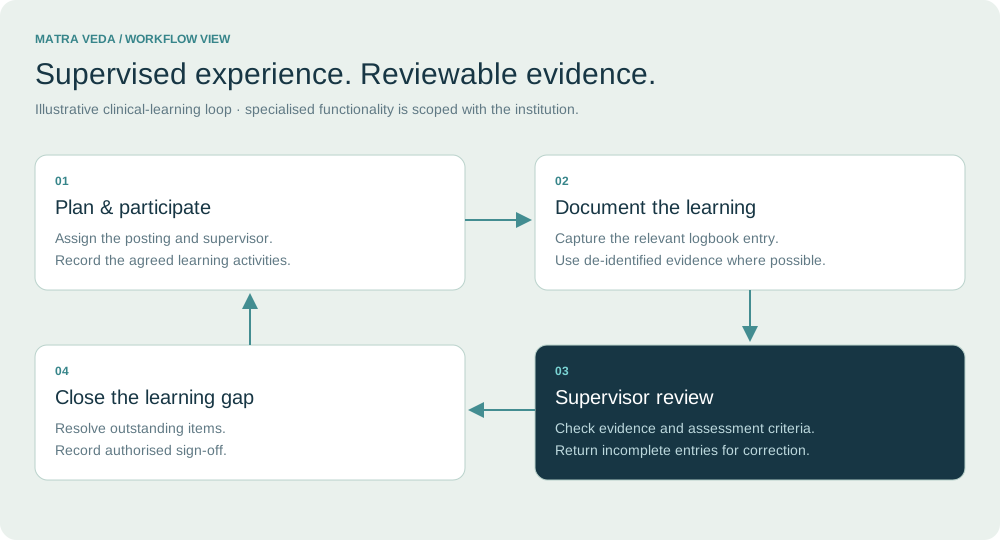
Connect the learning plan to supervised experience. This illustrative workflow shows the decisions to define before adding clinical training records.
Learning through practice
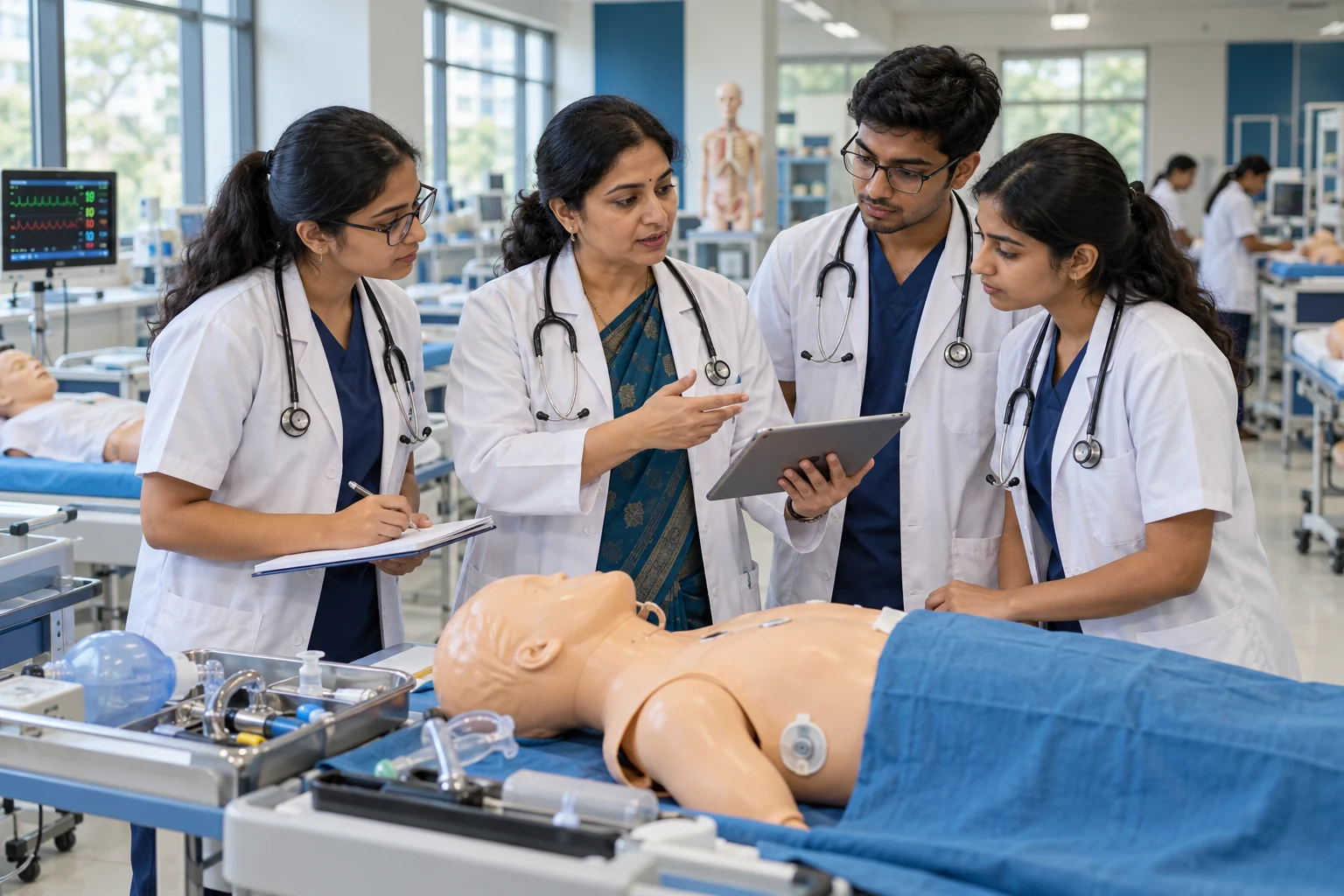
A skills session needs more than attendance: an agreed learning objective, supervised practice and a review of the evidence.
Illustrative Indian setting · AI-generatedDefine logbook templates, review ownership and the relevant academic outcomes.
Use de-identified learning records where possible. Clinical record access requires a separately agreed permission model.
Confirm the hospital system, approved exchange and vendor support before promising a live connection.
Illustrative additional workflow. Configuration, development and hospital-system integration depend on the agreed institutional scope.

At the bedside
In an ICU, bedside care depends on the local clinical team. A coordinated digital workflow can help organise case context, review notes and hand-offs when included in the agreed implementation scope.
Start with a task people recognise
AI is most useful when it fits a defined task. Choose one repeated workflow, agree what a good output looks like and check the result with the person responsible.
Illustrative Indian setting · AI-generatedOperational analysis
Build an analysis around a defined management question, rather than adding another dashboard without an owner.
Review pending referrals, unclosed tasks and time between hand-offs. Assign an owner to the oldest unresolved item.
Review bed utilisation, staffing coverage and workflow backlogs by unit. Investigate the context before changing capacity.
Review due, completed and overdue follow-up tasks. Distinguish scheduled activity from a confirmed patient response.
Frequently asked questions
Understand the scope, dependencies and decisions that matter for your institution.
Do not assume that the college ERP replaces a hospital information system or an electronic medical record. The healthcare page describes coordination and additional clinical-learning requirements; exact clinical functionality and integrations need separate validation.
The clinical-learning diagram outlines a workflow to scope: plan postings, record participation, document learning, obtain supervisor review and resolve gaps. Logbook formats and assessment criteria must be agreed before implementation.
The illustrated AI uses focus on tasks such as document checks, drafting summaries and preparing follow-up information. Human review is required. The website does not promise autonomous diagnosis, prescribing or bedside decisions.
Clinical learning should use de-identified records where possible. Any access to identifiable clinical information needs an explicitly agreed permission and governance model; it should not be assumed from academic access.
The enquiry form is configured to deliver to ajay@thinkmatra.io through FormSubmit. Email delivery requires the recipient’s one-time activation. Please use the form for institutional enquiries, not patient information.
Explore the institutional fit
Tell us about your institution, priorities and current systems. Your enquiry will go to the Matra team.
Download the A4 brochure